
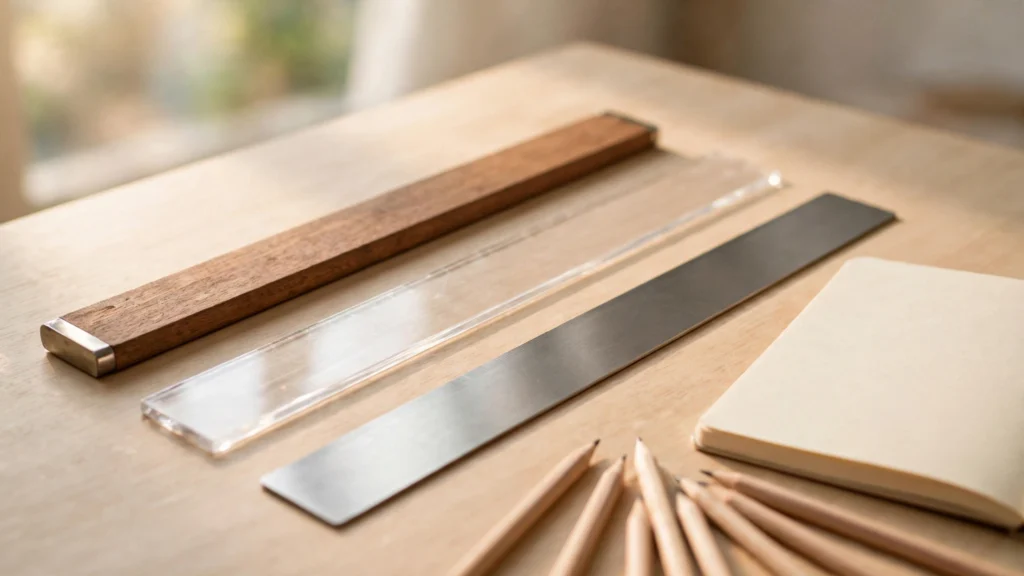

It’s probably sitting in a drawer ten feet from you right now: a flat strip of wood, plastic, or metal with little lines etched along its edge. The ruler is one of humanity’s oldest and most democratic tools — no batteries, no calibration certificates, no learning curve. Yet ask a roomful of adults to measure something to the nearest sixteenth of an inch, and you’ll watch confidence evaporate.
A ruler is a straight-edged instrument used to measure distances and draw straight lines. Most rulers you’ll meet are 12 inches (30 centimeters) long and carry two measurement systems — inches on one edge, centimeters on the other. Simple as it looks, reading one correctly takes a little know-how, especially when fractions enter the picture.
This guide covers everything worth knowing about the humble ruler: what it is, a short history, the main types, the materials they’re made from, exactly how to read one in inches and centimeters, conversion tricks, tips for accurate measuring, and answers to the questions people ask most.
What Is a Ruler?
At its simplest, a ruler is a straight strip marked with evenly spaced units of length. It does two jobs: it measures (how long is this?) and it guides (draw me a straight line). That second job is why the word “ruler” also means someone who governs — both keep things straight.
The standard school and office ruler is 12 inches long, which equals one foot or 30.48 centimeters. One edge is typically marked in inches (the imperial system), divided into halves, quarters, eighths, and sixteenths. The opposite edge is marked in centimeters, each divided into 10 millimeters. Flip it over, and you hold two measurement systems in one hand.
Rulers show up everywhere precision matters at a human scale: classrooms, workshops, sewing rooms, drafting tables, kitchens, and craft desks. For longer distances you’d reach for a tape measure; for microscopic tolerances, a caliper. The ruler owns the middle ground — roughly zero to twelve inches — and it owns it well.
A Brief History of the Ruler
People have been standardizing length for a very long time. Ancient Egyptians used cubit rods — wooden or stone bars marked in cubits, palms, and fingers — to lay out pyramids and temples around 3000 BCE. Archaeologists excavating Mohenjo-daro in the Indus Valley found an ivory ruler dating to roughly 1500 BCE, its tiny divisions accurate to a fraction of a millimeter — remarkably, it used decimal subdivisions thousands of years before the metric system.
The 12-inch ruler descends from the foot, one of the oldest units of length, traditionally based on — you guessed it — a human foot. Various kings standardized it over the centuries (the legend that it was King Henry I’s own foot is probably just a story), and the modern inch was internationally fixed at exactly 25.4 millimeters in 1959.
Today’s rulers are mass-produced in wood, plastic, and steel, but the concept hasn’t changed in five thousand years: a straight edge, honestly divided. There’s something reassuring about a tool that ancient that still works perfectly.
Types of Rulers
Not all rulers are the flat 12-inch stick from your pencil case. Different jobs created different rulers:
School / Office Ruler (12 inch / 30 cm)
The classic. Usually wood or clear plastic, marked in inches on one edge and centimeters on the other. Perfect for homework, drawing lines, and everyday measuring. The transparent plastic versions are popular because you can see the paper through them while lining things up.
Steel / Machinist’s Ruler
Made of stainless steel with etched (not printed) graduations, these are the precision option — they don’t warp, swell, or wear down. Machinist’s rules often divide inches into 32nds or even 64ths for fine metalwork. Carpenters and engineers trust steel because the markings stay accurate for decades.
Folding Ruler (Carpenter’s Rule)
A series of wooden or plastic segments joined by hinges, typically unfolding to 6 feet (2 meters). It folds down to pocket size, making it the traditional carpenter’s companion — though the tape measure has largely replaced it on job sites.
Yardstick and Meter Stick
A yardstick is 36 inches (3 feet) of flat wood or metal; a meter stick is 100 centimeters. Teachers wave them at blackboards, fabric stores measure cloth with them, and they’re handy for anything too long for a 12-inch ruler but too short for a tape measure.
Flexible / Bendable Ruler
Made of soft plastic or rubber, these bend to measure curved surfaces — the hem of a garment, the circumference of a jar. They trade a little accuracy for versatility.
T-Square
A drafting essential: a long blade fixed at a right angle to a shorter head that hooks over the edge of a drawing board. It draws perfectly horizontal lines and guides triangles for verticals and angles. Architects and engineers lived by these before CAD.
Architect’s and Engineer’s Scales
Triangular rulers with multiple calibrated edges for reading scaled drawings — e.g., 1/4 inch on paper equals 1 foot in real life. They don’t measure real objects; they translate between drawing and reality.
Ruler Materials Compared
| Material | Pros | Cons | Best for |
|---|---|---|---|
| Wood | Cheap, classic feel, won’t scratch surfaces | Can warp, chip, or wear at the ends | School, general use |
| Plastic (clear) | See-through for alignment, light, inexpensive | Can crack, scratch, or melt near heat | Students, drafting, crafts |
| Stainless steel | Extremely durable, etched marks never fade, stays straight | Heavier, pricier, can scratch delicate surfaces | Workshops, precision work |
| Aluminum | Light, rust-proof, affordable | Softer — edges dent more easily than steel | General purpose, field work |
For most people, a clear plastic 12-inch ruler covers daily life. If you measure for a living — woodworking, metalwork, sewing — upgrade to steel. The old workshop saying applies: buy the best measuring tool you can afford, because every cut you make inherits its errors.
How to Read a Ruler in Inches
This is the skill most people fumble. An inch ruler looks like a forest of ticks, but there’s a strict hierarchy — longer lines mean bigger fractions. Learn the hierarchy once and you’ll read any inch ruler forever.
The Line Hierarchy
- Inch marks (longest, numbered): the big lines labeled 1 through 12. Each spans one full inch.
- Half-inch marks (second longest): exactly midway between inch marks. Between 0 and 1, the half-inch mark means 1/2″.
- Quarter-inch marks: midway between each inch and half-inch mark. Shorter than half-inch lines.
- Eighth-inch marks: the next size down, splitting each quarter in half.
- Sixteenth-inch marks (shortest): the tiniest ticks — the smallest division on most rulers.
Reading Fractions Step by Step
Say an object’s end falls between the 2-inch and 3-inch marks. Here’s the method:
- Read the whole inches first: the last numbered mark the object passes is 2.
- Count the small ticks past the 2-inch mark. Suppose there are 5 tiny ticks.
- Identify the tick size. If the smallest ticks are sixteenths, 5 ticks = 5/16.
- Combine: 2 and 5/16 inches (written 2 5/16″).
The trick is always knowing your smallest tick. Count how many tiny divisions fit in one inch: 16 means sixteenths, 8 means eighths. Then just count ticks and reduce the fraction if you can (8/16 = 1/2).
Inch Fractions at a Glance
| Fraction | Decimal | Millimeters (approx.) |
|---|---|---|
| 1/16″ | 0.0625 | 1.59 mm |
| 1/8″ | 0.125 | 3.18 mm |
| 1/4″ | 0.25 | 6.35 mm |
| 3/8″ | 0.375 | 9.53 mm |
| 1/2″ | 0.5 | 12.7 mm |
| 5/8″ | 0.625 | 15.88 mm |
| 3/4″ | 0.75 | 19.05 mm |
| 7/8″ | 0.875 | 22.23 mm |
| 1″ | 1.0 | 25.4 mm |
How to Read a Ruler in Centimeters and Millimeters
Flip your ruler over and life gets simpler. The metric side is beautifully logical:
- The long numbered lines are centimeters — labeled 1 through 30 on a standard ruler.
- Between each centimeter are 10 millimeters — 9 small ticks plus the next centimeter line. Each small tick = 1 mm.
- The slightly longer tick at the halfway point marks 5 mm (half a centimeter).
To measure: align the object’s edge with the zero mark, then read the last full centimeter plus the extra millimeter ticks. If an object reaches the 7 cm line plus 4 small ticks, it’s 7.4 cm, or 74 mm. No fractions, no reducing — just count.
This simplicity is why most of the world uses metric. Carpenters in the US may swear by sixteenths, but ask anyone who’s switched: decimals beat fractions for speed and error-free math.
Inches to Centimeters: Quick Conversion
The magic number is 2.54 — one inch equals exactly 2.54 centimeters. To convert, multiply inches by 2.54; to go the other way, divide centimeters by 2.54.
| Inches | Centimeters |
|---|---|
| 1″ | 2.54 cm |
| 2″ | 5.08 cm |
| 3″ | 7.62 cm |
| 6″ | 15.24 cm |
| 12″ (1 foot) | 30.48 cm |
| 36″ (1 yard) | 91.44 cm |
Handy approximations for everyday use: 1 inch ≈ 2.5 cm, 4 inches ≈ 10 cm, 12 inches ≈ 30 cm. Close enough for estimating; use 2.54 when it counts.
How to Choose the Right Ruler
Buying a ruler isn’t complicated, but a few choices matter:
- Length: 12 inches / 30 cm covers most needs. Get an 18-inch or a yardstick if you regularly measure larger objects.
- Units: choose a dual-scale ruler (inches on one edge, centimeters on the other) unless you work exclusively in one system.
- Material: clear plastic for school and drafting (you can see through it), stainless steel for workshops and anything involving blades.
- Readability: look for high-contrast, etched or laser-printed markings. Cheap rulers with blurry printing cause misreads.
- Extras: a cork or foam backing stops the ruler slipping on paper; beveled edges make it easier to mark precisely; a hanging hole keeps it off the desk and out of harm’s way.
You don’t need to spend much — a good steel ruler costs less than a takeaway meal and will outlive you. Avoid ultra-cheap rulers with misaligned printing; test any new ruler against a known-good one before trusting it.
How to Measure Accurately: 8 Tips
Owning a ruler and measuring well are different skills. These habits separate rough guesses from reliable numbers:
- Start at zero — or don’t. Align the object’s edge with the 0 mark, not the physical end of the ruler. If the end is worn or chipped, start at the 1-inch (or 10 mm) mark instead and subtract.
- Look straight down. Read the mark with your eye directly above it. Viewing at an angle causes parallax error — the mark appears shifted. This single habit fixes most “wrong” measurements.
- Keep the ruler flat and still. Don’t lift or shift it mid-measurement. For a series of marks along one line, leave the ruler in place until all are done.
- Use the right-sized tool. Don’t measure 11 inches with a 6-inch ruler flipped end-to-end — each repositioning adds error. And don’t use a yardstick for a 2-inch bolt.
- Mark with a sharp pencil or knife. A fat marker line can be a sixteenth of an inch wide — wider than your tolerance. A sharp pencil or marking knife keeps lines honest.
- Mind the thickness. For the most accurate marking, stand the ruler on edge so the graduations touch the workpiece directly.
- Measure twice, cut once. The old carpenter’s proverb exists because remeasuring catches the silly mistakes — misread fractions, slipped rulers, wrong units.
- Double-check your units. Inches vs. centimeters is the classic blunder (it famously doomed a Mars orbiter). Glance at which edge you’re reading before you commit.
Common Ruler Mistakes to Avoid
- Starting at the 1 instead of 0. The first numbered mark is one inch from zero — measuring from the 1 adds a phantom inch.
- Confusing 1/4″ and 1/2″ marks. Remember the hierarchy: longer line = larger fraction. When in doubt, count ticks from the last inch mark.
- Reading the wrong edge. Flipping between inches and centimeters mid-project produces impressively wrong results.
- Ignoring the worn end. Wooden rulers get chewed up at the ends over years; that missing sixteenth throws off every measurement.
- Measuring round objects with a flat ruler. For diameters and circumferences, use calipers or a flexible tape — a rigid ruler just approximates.
Ruler vs. Tape Measure vs. Caliper
Three tools, three jobs. Here’s how to pick:
| Tool | Range | Precision | Best for |
|---|---|---|---|
| Ruler | 0–12″ (0–30 cm) | ~1/16″ (1 mm) | Paper, small objects, drawing lines |
| Tape measure | Up to 25+ ft | ~1/16″ (1 mm) | Rooms, lumber, long distances |
| Caliper | 0–6″ typical | 0.001″ (0.02 mm) | Machining, jewelry, engineering |
Rule of thumb: if it fits on a desk, use a ruler. If you have to walk it, use a tape. If a thousandth of an inch matters, use a caliper.
Everyday Uses Beyond Measuring
The ruler’s second career as a straightedge is almost as distinguished as its first:
- Drawing straight lines — underlining, diagrams, borders, and fold guides.
- Paper tearing and folding — score along the edge for crisp folds; guide clean tears.
- Cutting guide — run a craft knife along a steel ruler for straight cuts (never use a plastic ruler with a blade).
- Bookmark — the original multitasker.
- Garden depth gauge — poke it into soil to check planting depth.
- Level in a pinch — a ruler on edge with a marble or a phone level app can substitute for a spirit level on small jobs.
- Teaching fractions — few classroom tools make halves, quarters, and eighths as tangible as an inch ruler.
Do You Still Need a Physical Ruler?
Phones now ship with measuring apps, and plenty of websites offer on-screen rulers. They’re handy in a pinch — measuring a small object with your phone when no ruler is around beats guessing. But they have real limits: screen sizes vary (an “inch” on screen is only accurate if the app knows your display), holding a phone steady against an object is awkward, and you can’t draw a straight line with an app.
The verdict: apps are a backup, not a replacement. A physical ruler costs almost nothing, never needs charging, and doubles as a straightedge. Keep one in the drawer; use the app only when the drawer is far away.
Teaching Kids to Read a Ruler
The ruler is many children’s first encounter with fractions — which makes it a brilliant teaching tool:
- Start with whole inches. Have kids measure books and boxes to the nearest inch before introducing any fractions.
- Introduce halves, then quarters. Fold paper strips to show what 1/2 and 1/4 physically mean before pointing at tiny ticks.
- Use the metric side for confidence. Counting millimeters (1, 2, 3…) is far less intimidating than reducing fractions, and early wins build momentum.
- Make it a game. “Find something exactly 5 1/2 inches long” turns the living room into a treasure hunt.
- Connect to real life. Measuring ingredients, heights, and craft projects shows why the skill matters — the fastest route to caring about precision.
Frequently Asked Questions
What is a ruler used for?
A ruler is used to measure short distances — typically up to 12 inches or 30 centimeters — and to draw straight lines. You’ll find rulers in classrooms, offices, workshops, sewing rooms, and craft desks, anywhere small-scale accuracy matters.
How do you read a ruler in inches?
Find the last whole inch the object passes, then count the small ticks beyond it. The longest numbered lines are inches; the next-longest are half inches, then quarters, eighths, and sixteenths (the smallest ticks). Add the fraction to the whole inches — for example, 3 inches plus 5 sixteenth-inch ticks equals 3 5/16 inches.
How many centimeters are on a 12-inch ruler?
A 12-inch ruler is 30.48 centimeters long, so the metric edge shows 30 full centimeters (plus a few extra millimeters at the end). Each centimeter divides into 10 millimeters, giving 300+ millimeter ticks along the edge.
What are the small lines on a ruler?
On the inch side, the small lines are fractions of an inch: halves, quarters, eighths, and sixteenths — with shorter lines meaning smaller fractions. On the centimeter side, the small lines are millimeters, ten per centimeter.
What’s the difference between a ruler and a tape measure?
A ruler is rigid and best for short, precise measurements up to 12 inches, plus drawing straight lines. A tape measure is flexible and retractable, designed for long distances like rooms and lumber. Use a ruler when it fits on a desk; use a tape when you have to walk the distance.
Conclusion
The ruler endures because it does one thing perfectly: it turns the abstract idea of length into something you can see, touch, and trust. From Egyptian cubit rods to the steel rule in a modern workshop, five thousand years of builders, students, and makers have relied on a straight edge honestly divided.
Now you know how to read both edges — the fractions, the hierarchy of ticks, the metric simplicity, and the habits that keep measurements honest. Grab the nearest ruler and measure something. Once you can read it confidently, you’ll wonder why it ever looked complicated.