
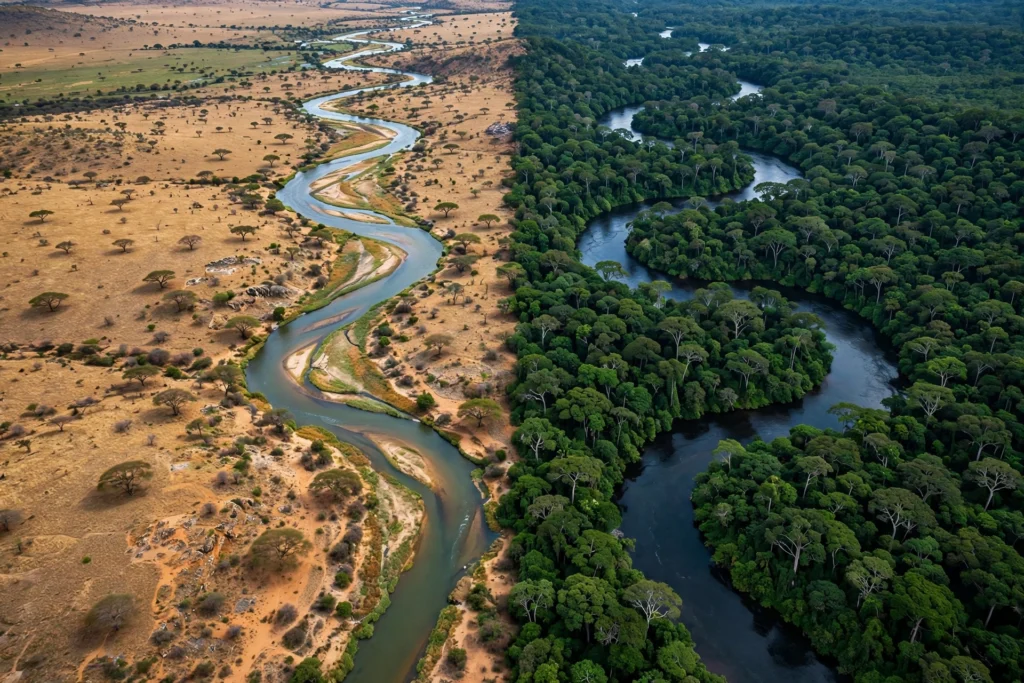

What is the longest river in the world? The official answer: the Nile — recognized by Guinness World Records, Encyclopaedia Britannica, the U.S. Geological Survey, and the UN at 6,650 km (4,132 miles). But the Amazon has a passionate counter-claim, and the debate rages on into 2026.
This guide gives you the honest verdict, explains why the Nile vs. Amazon debate exists (it’s about how you define a river’s “source”), covers the latest expeditions and measurements, ranks the top 10 longest rivers, and answers whether “longest” also means “biggest.”
Spoiler: it doesn’t — and the Amazon wins the categories that matter more.
The Verdict: Nile Is Officially the Longest
| River | Official length (Britannica) | Longest claimed length |
|---|---|---|
| Nile | 6,650 km (4,132 mi) | up to 6,853–7,088 km (some studies) |
| Amazon | 6,400 km (3,977 mi) | 6,800–6,992 km (Brazilian sources) |
As the Washington Post put it in 2023: “Guinness World Records, Britannica and the U.S. government agree: The longest river in the world is the mighty Nile… But in Brazil… the Nile’s standing is slightly lower.”
Why the Debate Exists: The “Source” Problem
The whole fight comes down to one question: where does a river begin?
- Principal source: the farthest point along the main channel (the route with the most water).
- Most distant source: the absolute farthest upstream trickle anywhere in the basin — even a small tributary.
These two points often don’t coincide — and that gap is the entire Nile–Amazon fight. Brazil’s longer Amazon figures use the most-distant-source method; most institutions use conventional headwaters.
Why it’s so hard in practice:
- Rivers have many tributaries — which one “counts” as the origin?
- Farthest sources sit in remote mountains (Nile: Burundi’s highlands; Amazon: the Andes).
- Rivers shift course, especially in floodplains like the Amazon basin.
- Satellite vs. ground surveys differ by 100+ miles; measuring through lakes and reservoirs is ambiguous.
The Latest Measurements and Expeditions
- 2000 Brazil/Peru expedition (Guido Gelli): measured from Nevado Mismi → Amazon at 6,850 km, “at least 100 miles longer than the Nile” (Scientific American).
- 2007 Brazilian expedition claimed 6,800 km but never published findings — methods questioned by the scientific community.
- 2014 paper (still cited in 2026): the most distant Amazon source is the Río Mantaro at Cordillera Rumi Cruz — but it runs dry ~5 months a year due to the Tablachaca dam (1974), so many geographers reject it as a true “source.”
- April 2024 expedition: Brazilian filmmaker Yuri Sanada’s team (“To the Riverhead of the Amazon”) traveled from Apacheta Creek to the river’s mouth in solar-powered boats to prove the Amazon is longer.
- 2026 re-measurement claims: some recent sources put the Nile at 6,853 km — showing the debate continues into 2026.
The Nile: A Closer Look
- Flows northward — rare among major rivers — from the African Great Lakes region to the Mediterranean Sea.
- Passes through 11 countries: Egypt, Sudan, South Sudan, Ethiopia, Uganda, Kenya, Tanzania, Rwanda, Burundi, DRC, and Eritrea.
- Sustained ancient Egyptian civilization; Britannica calls it the “Father of African rivers.”
- Its annual flooding deposited the fertile silt that made Egyptian agriculture possible for millennia.
- Despite its length, its discharge (~2,500–2,800 m³/s) is modest — it’s a long, thin river.
The Amazon: A Closer Look
- Begins in the Peruvian Andes (Apurímac headwaters per Britannica) and flows east across the continent to the Atlantic Ocean.
- Drains a basin covering parts of 7 countries, centered on Brazil.
- Carries more water than the next 7 largest rivers combined — a true giant.
- Home to the Amazon rainforest and an estimated 10% of known species on Earth.
- So wide in places that it’s been called a “river sea” — you can’t see the far bank.
Other Contenders Through History
The Nile–Amazon debate isn’t new. Over the decades, the Mississippi–Missouri system was once claimed as the world’s longest by some American sources, and the Yangtze occasionally enters the conversation in Chinese publications. Each claim collapses under the same problem: changing the source definition changes the ranking — which is why institutions stick to consistent, conventional measurements.
Top 10 Longest Rivers in the World
| # | River | Length | Countries / Continent | Fun fact |
|---|---|---|---|---|
| 1 | Nile | 6,650 km / 4,132 mi | 11 African nations | Flows northward; sustained ancient Egypt — “Father of African rivers” |
| 2 | Amazon | 6,400 km / 3,977 mi | Brazil, Peru, Colombia | Biggest by discharge — more water than the next 7 rivers combined |
| 3 | Yangtze | 6,300 km / 3,915 mi | China | Longest river in Asia; home to the Three Gorges Dam |
| 4 | Mississippi–Missouri | 6,275 km / 3,902 mi | USA, Canada | Longest river system in North America |
| 5 | Yenisei–Angara | 5,539 km / 3,445 mi | Russia, Mongolia | Drains into the Arctic Ocean |
| 6 | Yellow River | 5,464 km / 3,395 mi | China | “Cradle of Chinese civilization” |
| 7 | Ob–Irtysh | 5,410 km / 3,364 mi | Russia, Kazakhstan, China, Mongolia | Vital Siberian water-transport corridor |
| 8 | Paraná–Río de la Plata | 4,880 km / 3,030 mi | Brazil, Argentina, Paraguay, Bolivia, Uruguay | Major South American river system |
| 9 | Congo | 4,700 km / 2,922 mi | DRC + 8 others | Deepest river in the world; 2nd by discharge |
| 10 | Amur | 4,444 km / 2,763 mi | Russia, China, Mongolia | Forms the Russia–China boundary |
Longest vs. Biggest vs. Deepest: Three Different Crowns
| Title | Winner | The number |
|---|---|---|
| Longest | Nile | 6,650 km (official) |
| Biggest (discharge) | Amazon | ~209,000–230,000 m³/s — 17–20% of all river water on Earth; the Nile carries only ~2,500–2,800 m³/s |
| Deepest | Congo | Over 220 m deep in places |
So while the Nile takes “longest,” the Amazon is unquestionably the mightiest river on the planet.
How Rivers Are Measured
- Find the source: identify the most distant headwater (or the conventional source).
- Trace the channel: follow the longest continuous watercourse — through every meander, not a straight line.
- Measure to the mouth: where the river meets the sea or ocean.
- Decide the hard cases: through lakes? reservoirs? seasonal channels? Different answers = different lengths.
Frequently Asked Questions
What is the longest river in the world?
The Nile is officially recognized as the longest river in the world at 6,650 km (4,132 miles) — per Guinness World Records, Encyclopaedia Britannica, the USGS, and the UN. The Amazon has competing claims (up to ~6,992 km) based on disputed source definitions.
Is the Amazon longer than the Nile?
Not by official measures. Brazilian expeditions have claimed 6,800–6,992 km for the Amazon using the “most distant source” method, but Guinness, Britannica, and the USGS all recognize the Nile as longer. The debate depends entirely on where you define each river’s source.
Why is there a debate about the longest river?
Because river length depends on where you start measuring. The “principal source” (farthest point along the main channel) and the “most distant source” (absolute farthest trickle in the basin) give different answers. Remote mountain sources, shifting floodplain channels, seasonal drying, and different survey methods all move results by 100–300 km.
How are rivers measured for length?
Length = the longest continuous channel from the most distant headwater source to the mouth, following every meander. In practice, geographers combine satellite GIS, LiDAR, and field surveys — and must make judgment calls about lakes, reservoirs, and seasonal channels.
What is the longest river in Asia — and the biggest by water volume?
The Yangtze is Asia’s longest river (6,300 km). The Amazon is the biggest river by water volume by a huge margin — discharging ~209,000–230,000 m³/s, about 17–20% of all river flow on Earth.
Conclusion
The Nile holds the official crown as the longest river in the world — but the honest answer is that “longest” depends on where you draw the starting line. The Amazon’s counter-claim isn’t settled, and new expeditions keep the debate alive.
Whatever wins on length, the Amazon is the undisputed heavyweight — and the Congo the deepest. Geography rarely hands out just one trophy.
Explore more on StarsInfos.