
Animal Farm is George Orwell’s 1945 political satire and allegorical novella — a farm fable about pigs who overthrow a human farmer, then become indistinguishable from the tyrants they replaced. Beneath the simple story lies a devastating allegory of the Russian Revolution and the rise of Stalinist totalitarianism.
This 2026 guide covers everything about the Animal Farm book: publication facts, the full plot summary, every character and who they represent, the Seven Commandments (original vs corrupted), the Russian Revolution timeline mapping, themes, famous quotes, why it was banned, and all film adaptations.
Animal Farm: Book Facts
| Fact | Detail |
|---|---|
| Title | Animal Farm: A Fairy Story |
| Author | George Orwell (Eric Arthur Blair, 1903–1950) |
| Published | 17 August 1945 (Secker & Warburg, London) |
| Written | 1943–1944 |
| Genre | Political satire / allegorical novella / dystopian fable |
| Length | ~112 pages, ~30,000 words, 10 chapters |
| Sales | 11M+ copies; never out of print |
Orwell described his purpose in his 1946 essay Why I Write: the book was written “against totalitarianism and for democratic socialism.” Orwell was himself a democratic socialist — the book attacks Stalinism, not the idea of equality. It was rejected by several publishers during the war, when criticizing the Soviet Union was politically sensitive.
Plot Summary (Full — Spoilers)
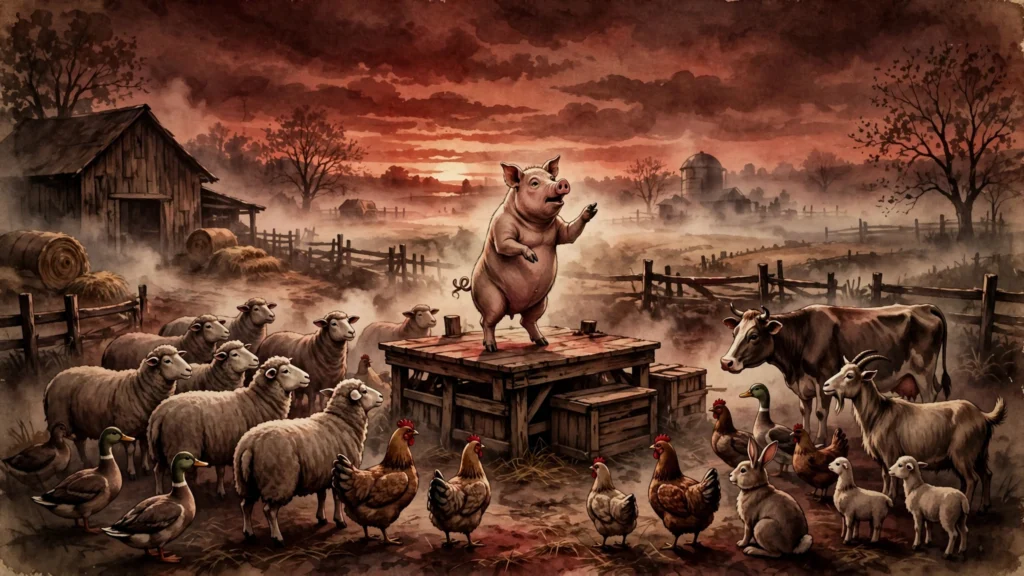
On Manor Farm, drunken Mr. Jones neglects his animals. Old Major, a prize boar, gives a revolutionary speech about animal freedom, teaches the anthem “Beasts of England,” and dies three days later. When Jones forgets to feed them, the animals rebel, drive him off, and rename the farm Animal Farm.
The pigs Napoleon and Snowball take leadership, establishing Animalism and the Seven Commandments (“All animals are equal”). The two pigs clash — especially over Snowball’s windmill plan. Napoleon has nine secretly-trained dogs chase Snowball off the farm, abolishes democratic meetings, and rules through Squealer’s propaganda and terror.
The commandments are corrupted one by one. Boxer, the loyal workhorse, is sold to the knacker when injured. The pigs trade with humans, drink alcohol, wear clothes, and finally walk on two legs. The novella ends with the pigs hosting human farmers for dinner — and the watching animals find it “impossible to say which was which” between pig and man.
Characters and Who They Represent
Every major character is an allegory for a figure or group in the Russian Revolution and Soviet Union:
| Character | Represents |
|---|---|
| Napoleon | Joseph Stalin |
| Snowball | Leon Trotsky (exiled, later denounced) |
| Old Major | Karl Marx / Vladimir Lenin |
| Squealer | Propaganda machine (Pravda / Molotov) |
| Boxer | Exploited working class — “I will work harder” |
| Clover | Maternal conscience of the people |
| Benjamin | Skeptical intellectuals (Orwell himself) |
| Moses (raven) | Organized religion (“Sugarcandy Mountain” = heaven) |
| Mr. Jones | Tsar Nicholas II |
| Mr. Frederick | Adolf Hitler (attacks the farm = Nazi invasion) |
| Mr. Pilkington | Britain / Churchill / Western Allies |
| The sheep | Unthinking masses (“Four legs good, two legs bad”) |
| The dogs | Secret police (NKVD/KGB) |
| Mollie | Bourgeoisie — flees revolution for comfort |
| The pigs (collectively) | Communist Party elite |
The Seven Commandments: Original vs Corrupted
The commandments’ gradual corruption is the novel’s central image of betrayed ideals:
| # | Original | Corrupted version |
|---|---|---|
| 1 | Whatever goes on two legs is an enemy | (abandoned — pigs walk on two legs) |
| 2 | Whatever goes on four legs, or has wings, is a friend | (abandoned) |
| 3 | No animal shall wear clothes | (pigs wear clothes) |
| 4 | No animal shall sleep in a bed | …with sheets |
| 5 | No animal shall drink alcohol | …to excess |
| 6 | No animal shall kill any other animal | …without cause |
| 7 | All animals are equal | …but some animals are more equal than others |
Russian Revolution Timeline in the Novel
| Novel event | Historical parallel |
|---|---|
| Old Major’s speech | Marx’s writings; 1917 revolutionary buildup |
| The Rebellion | October Revolution, 1917 |
| Jones expelled | Tsar Nicholas II overthrown |
| Snowball vs Napoleon | Trotsky vs Stalin power struggle |
| Windmill debate | Industrialization / Five-Year Plans |
| Snowball expelled | Trotsky exiled, 1929 |
| Confessions and executions | The Great Purge, 1936–38 |
| Battle of the Windmill | WWII / Battle of Stalingrad |
| Pigs dine with humans | Tehran Conference, 1943 |
Chapter-by-Chapter Summary (Brief)
- Ch 1: Old Major’s revolutionary speech; “Beasts of England.”
- Ch 2: Old Major dies; the Rebellion; Jones expelled; Seven Commandments painted.
- Ch 3: The harvest; pigs take the milk and apples; Snowball vs Napoleon emerge.
- Ch 4: News spreads; Jones attempts to retake the farm — Battle of the Cowshed.
- Ch 5: Windmill debate; Napoleon expels Snowball with the dogs.
- Ch 6: Napoleon announces the windmill will be built; first commandment altered (“with sheets”); trade with humans begins.
- Ch 7: Windmill collapses; Snowball blamed; hens’ rebellion crushed; “confessions” and executions.
- Ch 8: Commandments further altered (“to excess,” “without cause”); Battle of the Windmill vs Frederick.
- Ch 9: Boxer injured; sold to the knacker; Squealer’s lies; rations cut while pigs feast.
- Ch 10: Years pass; pigs walk on two legs; final commandment revealed; pigs dine with humans — indistinguishable.
Key Symbols in Animal Farm
- The windmill: industrialization and the Five-Year Plans — progress promised, suffering delivered.
- “Beasts of England”: revolutionary song/anthem — banned once Napoleon consolidates power (like the USSR dropping revolutionary anthems).
- The farmhouse: the seat of power — forbidden, then occupied by the pigs.
- Milk and apples: the first corruption — small privileges that foreshadow everything.
- Boxer’s hoof: the working class’s strength, exploited to the end.
- The final dinner: the complete cycle — revolutionaries become the old regime.
Essay Topics for Students
- How does Orwell use the corruption of the Seven Commandments to show the betrayal of revolutionary ideals?
- Analyze Squealer’s rhetoric — what propaganda techniques does he use?
- Compare Boxer and Benjamin: loyalty vs skepticism — which enables tyranny more?
- Is Animal Farm about the Russian Revolution specifically, or all revolutions?
- Discuss the significance of the ending — why does Orwell make pig and man indistinguishable?
Themes of Animal Farm
- Totalitarianism and the corruption of power: the famous arc from revolution to tyranny — power concentrated in the pigs corrupts absolutely.
- Propaganda and language: Squealer rewrites history and the commandments; language is the regime’s sharpest weapon.
- Betrayal of ideals: every principle of Animalism is hollowed out while its slogans remain.
- Class struggle: the pigs become a new aristocracy — the oppressed become the oppressors.
- The cycle of tyranny: the ending’s genius — the revolution ends exactly where it began.
- Political apathy: the sheep’s bleating and Boxer’s blind loyalty (“Napoleon is always right”) enable the tyranny.
Famous Quotes from Animal Farm
- “All animals are equal, but some animals are more equal than others.” — the corrupted Seventh Commandment.
- “Four legs good, two legs bad.” — the sheep’s mindless slogan (later amended to “…two legs better”).
- “I will work harder.” — Boxer’s motto.
- “Napoleon is always right.” — Boxer’s second motto; blind loyalty distilled.
- “Man is the only real enemy we have.” — Old Major’s revolutionary thesis.
- “The creatures outside looked from pig to man, and from man to pig… it was impossible to say which was which.” — the devastating final line.
Why Was Animal Farm Banned?
- Soviet Union and communist bloc: banned as anti-communist — it was literally about Stalin.
- China: banned for the same reason.
- Jackson County, Florida (1982): challenged as “pro-communist” — an ironic misreading of a book Orwell wrote against totalitarianism.
- The CIA angle: the book was considered so politically significant that the CIA covertly funded the 1954 animated film adaptation.
The irony: Orwell was a democratic socialist. The book attacks Stalinism, not equality — a distinction censors on both sides managed to miss.
Animal Farm Adaptations
| Year | Adaptation | Notes |
|---|---|---|
| 1954 | British animated film (Halas & Batchelor) | First British animated feature; covertly CIA-funded; ending changed — Napoleon is overthrown in a second revolution |
| 1999 | Live-action TV film (TNT/Hallmark) | Ending reflects the collapse of Soviet communism |
| 2025 | Animated film (dir. Andy Serkis) | Starring Seth Rogen as Napoleon; reimagined as a modern business-corruption allegory |
Stage adaptations include the National Theatre London (1984), Robert Icke’s 2022 version, and an opera by Alexander Raskatov (2023).
Animal Farm vs 1984
| Animal Farm (1945) | Nineteen Eighty-Four (1949) | |
|---|---|---|
| Form | Allegorical fable | Dystopian novel |
| Target | Russian Revolution → Stalinism | Totalitarianism in general |
| Tone | Satirical, deceptively simple | Bleak, terrifying |
| Read first? | Yes — shorter, more accessible | After, for the full Orwell |
How to Read Animal Farm (Study Tips)
- Read it twice: once as a story, once with the allegory table beside you.
- Track the commandments: note each change and what historical event it mirrors.
- Watch Squealer’s language: every speech is a masterclass in propaganda techniques.
- Compare the ending to the beginning: Jones’s farm vs Napoleon’s farm — what’s actually different?
- Pair with history: a basic Russian Revolution timeline makes the allegory click instantly.
Frequently Asked Questions
What is the book Animal Farm about?
Animal Farm is a political satire about farm animals who overthrow their human owner, establish an equal society — then watch the pigs become tyrants worse than the farmer. It’s an allegory of the Russian Revolution and Stalin’s rise, and a warning about how revolutions betray their ideals.
Who do the characters in Animal Farm represent?
Napoleon = Stalin, Snowball = Trotsky, Old Major = Marx/Lenin, Squealer = Soviet propaganda, Boxer = the exploited working class, Mr. Jones = Tsar Nicholas II, Mr. Frederick = Hitler, Mr. Pilkington = Churchill/the Allies, the dogs = the secret police, the sheep = the unthinking masses.
What are the Seven Commandments in Animal Farm?
The original commandments include “Whatever goes on two legs is an enemy” and “All animals are equal.” The pigs corrupt them one by one — adding “with sheets,” “to excess,” “without cause” — until only “All animals are equal, but some animals are more equal than others” remains.
What is the moral of Animal Farm?
The central moral: power corrupts, and revolutions that don’t guard their ideals reproduce the tyranny they overthrew. Orwell also warns that political apathy and blind loyalty (the sheep, Boxer) enable dictatorship — and that language is power’s sharpest tool.
Why was Animal Farm banned?
It was banned in the USSR, the communist bloc, and China as anti-communist (it satirizes Stalin). Ironically, it was also challenged in Florida in 1982 as “pro-communist” — a complete misreading. Orwell was a democratic socialist writing against totalitarianism.
Conclusion
Animal Farm endures because its warning is universal: every revolution risks becoming what it overthrew — unless ideals are guarded, language is watched, and power is questioned. At ~30,000 words, it’s one of the most efficient great books ever written: a fable a child can follow, an allegory a historian can unpack.
Read it for the story. Re-read it for the warning. Then read 1984 — Orwell’s darker, fuller vision of where the pigs’ road leads.
Explore more on StarsInfos.