
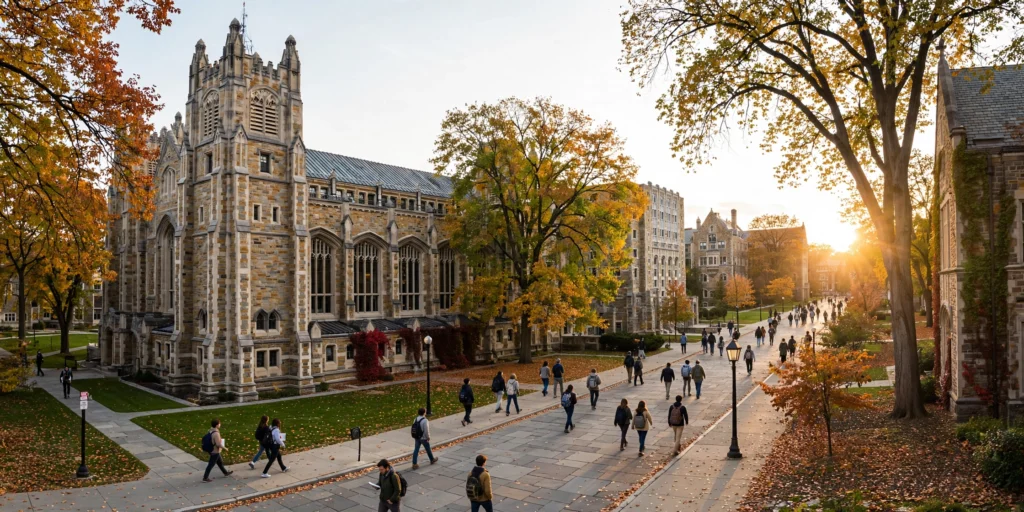

The University of Michigan acceptance rate for the Class of 2029 was 16.4% — 17,915 admitted out of 109,112 applicants. But that single number hides the most important fact about UMich admissions: in-state applicants are admitted at roughly 39%, while out-of-state applicants face roughly 17%. Residency nearly doubles your odds.
This 2026 guide covers the verified 5-year trend, the in-state vs out-of-state split, Early Action vs the new Early Decision program, GPA/SAT/ACT stats, school-by-school selectivity (including Ross Business), the transfer acceptance rate, and how UMich compares to UCLA and Harvard.
UMich Acceptance Rate: Quick Facts
| Stat | Figure |
|---|---|
| Overall (Class of 2029) | 16.4% (17,915 / 109,112) |
| In-state (estimated) | ~39% |
| Out-of-state (estimated) | ~17% |
| Class of 2028 | 15.6% (record low) |
| Class of 2030 | 115,125 applications (record); rate not yet released |
| Avg GPA (enrolled) | 3.9–4.0 unweighted |
| SAT middle 50% | 1360–1530 |
| ACT middle 50% | 31–34 |
| Transfer rate | ~35% (fall 2024) |
| Test policy | Test-optional (since winter 2025) |
5-Year Acceptance Rate Trend
| Class | Applications | Admitted | Rate |
|---|---|---|---|
| 2029 (fall 2025) | 109,112 | 17,915 | 16.4% |
| 2028 | 98,310 | 15,373 | 15.6% |
| 2027 | 87,632 | 15,722 | 17.9% |
| 2026 | ~84,000 | ~14,900 | 17.7% |
| 2025 | ~79,000 | ~16,000 | 20.2% |
| 2024 | ~65,000 | ~17,000 | 26.1% |
The trend is clear: applications have nearly doubled in five years while the admit count stayed flat — so the rate keeps falling. For the Class of 2030, a record 115,125 applications were submitted; analysts project the rate could fall to around ~12.5% (projection, not official).
In-State vs Out-of-State: The Residency Advantage
This is the single most important — and least understood — fact about UMich admissions:
| Residency | Estimated acceptance rate |
|---|---|
| Michigan residents | ~39% |
| Out-of-state | ~17% |
- UMich is a public university with a mission to serve Michigan students — roughly 52–53% of undergraduates are in-state.
- These residency rates are widely cited estimates, not officially published figures — but every admissions analyst agrees on the ~2× gap.
- What it means: a Michigan resident with a 3.8 GPA has a realistic shot; an out-of-state applicant needs near-perfect stats to be competitive.
Early Action vs Regular Decision (and New Early Decision)
| Round | Deadline | Decision | Notes |
|---|---|---|---|
| Early Decision (new!) | Nov 1 | By Dec 24 | Binding — introduced for the 2026–27 cycle |
| Early Action | Nov 1 | Late January | Non-binding; estimated ~20–25% admit rate |
| Regular Decision | Feb 1 | Early April | Lower admit rate than early rounds |
- UMich historically does not publish official early-round acceptance rates — the ~20–25% EA figure is an independent estimate.
- The new binding Early Decision program is a major change: applying ED signals UMich is your first choice, which typically boosts odds — but you’re committed if admitted.
- Application fee: $75.
What GPA and Test Scores Do You Need?
| Metric | Admitted student profile |
|---|---|
| GPA (unweighted) | 3.9–4.0 enrolled range; ~94% at 3.75+; average ~3.91 |
| SAT (middle 50%) | 1360–1530 (some sources 1410–1540); average ~1470 |
| ACT (middle 50%) | 31–34 (some sources 33–35); average ~33 |
| Course rigor | One of only two “very important” factors (with GPA) |
Test-Optional Policy
- UMich has been test-optional since winter 2025, confirmed for the 2026–27 cycle and beyond.
- In a recent cycle, 54% of admitted students submitted SAT scores and 24% submitted ACT — strong scores still help, especially out-of-state.
- Strategy: submit scores if they’re at or above the middle 50%; withhold if below.
School-by-School Selectivity
Not all UMich schools are equally hard to enter:
| School | Estimated acceptance rate | Notes |
|---|---|---|
| LSA (Literature, Science & Arts) | ~20% | Largest school; closest to the overall rate |
| Ross School of Business | ~7–10% | Among the most selective undergrad business programs in the US |
| Engineering | Below average | More competitive than LSA; strong math/science expected |
| Other schools | Varies | Smaller programs (Architecture, Music, Nursing) have their own criteria |
Ross note: Ross admits via a separate process — many students apply to Ross after enrolling at UMich (preferred admission as freshmen is extremely competitive).
Transfer Acceptance Rate
| Term | Applicants | Admitted | Rate |
|---|---|---|---|
| Fall 2024 | 6,832 | 2,385 | ~35% |
| Fall 2023 | — | — | ~34% |
| Fall 2022 | — | — | ~37% |
| Fall 2021 | — | — | ~42% |
| Fall 2020 | — | — | ~46% |
- The transfer rate (~35%) is roughly double the freshman rate — transferring is a legitimate back door, especially from Michigan community colleges.
- The transfer rate is also declining, so don’t count on it staying at 35%.
- Deadlines: fall transfer — Feb 1; winter transfer — Oct 1.
UMich vs UCLA vs Harvard
| Factor | UMich | UCLA | Harvard |
|---|---|---|---|
| Overall rate | 16.4% | ~9% | ~3–4% |
| In-state advantage | Huge (~39% vs ~17%) | Moderate (UC system) | None (private) |
| Avg GPA | 3.9–4.0 | ~3.9+ | ~4.0+ |
| SAT middle 50% | 1360–1530 | 1290–1510 | 1490–1580 |
| Test policy | Test-optional | Test-blind | Test-optional |
| Public/private | Public | Public | Private |
Bottom line: Harvard is in another universe of selectivity. UCLA is more selective overall than UMich — but a Michigan resident’s ~39% odds at UMich beat an in-state Californian’s odds at UCLA. Residency is UMich’s superpower.
How to Improve Your Chances
- Residency matters most. If you’re a Michigan resident, say so proudly — it’s your biggest statistical edge.
- Apply Early Action (or ED). Early rounds have higher admit rates; the new binding ED is the strongest signal of interest.
- GPA + rigor first. These are the two “very important” factors — a 3.9 with AP/IB courses beats a 4.0 in easy classes.
- Submit strong test scores. At/above the middle 50%? Submit. Below? Withhold under test-optional.
- Nail the essays. UMich’s supplemental essays (especially “Why Michigan?”) separate admits from waitlists — be specific about programs, professors, and campus opportunities.
- Show sustained extracurriculars. Depth over breadth; leadership and impact over laundry lists.
- Consider the transfer route. A strong year at a Michigan community college + ~35% transfer rate is a viable plan B.
Application Deadlines and Details
| Item | Detail |
|---|---|
| Early Decision | Nov 1 (binding; decision by Dec 24) |
| Early Action | Nov 1 (decision late January) |
| Regular Decision | Feb 1 (decision early April) |
| Application fee | $75 (waivers available) |
| Platform | Common Application |
| Transfer (fall) | Feb 1 |
| Transfer (winter) | Oct 1 |
What UMich Looks For
- Very important: GPA, course rigor.
- Important: essays, extracurriculars, recommendations, character.
- Considered: test scores (if submitted), talent, first-generation status, work experience.
- The “Why Michigan?” essay is critical — generic answers (“great academics, school spirit”) lose to specific ones (named programs, professors, research labs, clubs).
UMich Rankings and Reputation
- Consistently ranked among the top 3 public universities in the US (U.S. News).
- Ross School of Business: routinely top-5 undergraduate business programs nationally.
- Engineering: top-10 undergraduate engineering programs.
- One of the original “Public Ivies” — public price (for residents), Ivy-caliber academics and alumni network.
- Research powerhouse: billions in annual research spending; a top destination for pre-med, CS, and business.
Tuition and Financial Aid
| Cost (2025–26, approx.) | In-state | Out-of-state |
|---|---|---|
| Tuition & fees | ~$18,000 | ~$60,000 |
| Room & board | ~$14,000 | ~$14,000 |
| Total cost of attendance | ~$35,000 | ~$78,000 |
- The in-state vs out-of-state gap is enormous — another reason residency matters beyond admissions odds.
- UMich meets full demonstrated need for Michigan residents through programs like the Go Blue Guarantee (free tuition for in-state families under certain income thresholds).
- Out-of-state students should run the net price calculator early — merit scholarships exist but are competitive.
Waitlist: Your Odds and Strategy
- UMich waitlists thousands of applicants each year; historically, a small single-digit percentage is eventually admitted off the waitlist (e.g., ~5% for the Class of 2028).
- If waitlisted: accept the spot immediately, write a brief letter of continued interest with any new achievements, keep grades up, and — critically — commit to another school by May 1 while you wait.
- Waitlist movement happens mostly in May–June.
Deferred from Early Action? What to Do
- A deferral means you’ll be reconsidered in Regular Decision — it’s not a rejection.
- Send updates: fall grades, new awards, continued interest (one concise email/portal update).
- Don’t panic-apply to 20 more schools; strengthen the schools already on your list.
- Historically, a meaningful share of deferred EA applicants are admitted RD — your application was already competitive.
Common Application Mistakes to Avoid
- Generic “Why Michigan?” essay — the #1 killer. Name specific programs, professors, labs, and clubs.
- Applying to the wrong school — Ross (7–10%) vs LSA (~20%) are different games; apply where your profile fits.
- Ignoring course rigor — a 4.0 without AP/IB/honors loses to a 3.8 with rigor.
- Submitting weak test scores — under test-optional, a below-median score hurts more than no score.
- Missing the ED/EA deadline — Nov 1 comes fast senior year; RD odds are lower.
- Thin extracurriculars — one deep commitment beats six shallow ones.
Class of 2030: What to Expect
- Record 115,125 applications — the largest pool in UMich history.
- New binding Early Decision program debuts — expect ED admit rates well above RD.
- Analysts project the overall rate could fall to ~12.5% — but that’s a projection, not an official figure.
- Advice for 2030 applicants: treat UMich as a reach unless you’re in-state with strong stats; apply early; have safeties you genuinely like.
Campus and Student Life Snapshot
- Location: Ann Arbor, Michigan — the quintessential college town.
- Undergraduates: ~33,000; total enrollment ~52,000.
- Campus culture: Big Ten sports (the Big House seats 107,000+), 1,600+ student organizations, strong school spirit.
- Housing: guaranteed for freshmen; sophomores typically move off-campus.
Notable UMich Alumni
- Gerald Ford — 38th US President
- Larry Page — Google co-founder
- Arthur Miller — playwright (Death of a Salesman)
- Madonna — attended (did not graduate)
- Tom Brady — NFL legend
- Claude Shannon — father of information theory
How UMich Compares to Other Top Publics
| University | Overall rate | In-state edge |
|---|---|---|
| UMich | 16.4% | Very strong (~39% vs ~17%) |
| UCLA | ~9% | Moderate |
| UC Berkeley | ~11% | Moderate |
| UVA | ~17% | Strong |
| UNC Chapel Hill | ~17% | Very strong (mandated 82% in-state) |
| UT Austin | ~31% | Extreme (auto-admit top 6%) |
Among elite publics, UMich sits in the middle on overall selectivity — but its in-state advantage is among the largest, making it the best value proposition in American higher education for Michigan residents.
Gap Year and Reapplication
- UMich allows admitted students to defer enrollment for a gap year in most cases — request through the admissions office.
- Reapplying after rejection: allowed, but you need materially new information (better grades, new achievements). A near-identical reapplication rarely succeeds.
- The transfer route (~35%) remains the statistically stronger second chance.
Final Checklist Before You Apply
- ☐ Confirm your residency status (it changes everything)
- ☐ Choose ED, EA, or RD — and hit the Nov 1 or Feb 1 deadline
- ☐ GPA 3.9+ with rigorous courses (or a strong upward trend story)
- ☐ Test scores at/above median → submit; below → withhold
- ☐ “Why Michigan?” essay with specific programs and professors
- ☐ Pick the right school (LSA vs Ross vs Engineering)
- ☐ Recommendations from junior-year core teachers
- ☐ Run the net price calculator before falling in love
Frequently Asked Questions
What is the UMich acceptance rate?
16.4% for the Class of 2029 — 17,915 admitted out of 109,112 applicants. It was 15.6% for the Class of 2028 (a record low).
Is it harder to get into UMich out of state?
Yes, significantly. Michigan residents are admitted at an estimated ~39%, vs ~17% for out-of-state applicants. Residency roughly doubles your odds.
What GPA do you need for UMich?
Enrolled students average 3.9–4.0 unweighted, with ~94% at 3.75 or above. Course rigor (AP/IB/honors) matters as much as the number.
Is UMich test-optional?
Yes — test-optional since winter 2025, confirmed for the 2026–27 cycle and beyond. Submit scores only if they’re at or above the middle 50% (SAT 1360–1530, ACT 31–34).
What is the UMich transfer acceptance rate?
~35% for fall 2024 (2,385 admitted of 6,832) — roughly double the freshman rate, making transfer a viable path, especially from Michigan community colleges.
Conclusion
The University of Michigan acceptance rate of 16.4% tells only half the story. For Michigan residents, UMich remains remarkably accessible at ~39%; for out-of-state students, it’s a ~17% reach demanding near-perfect academics. The 5-year trend — applications doubling while admits stay flat — means every cycle gets tougher.
Your playbook: apply early (EA or the new binding ED), maximize GPA and rigor, submit strong scores if you have them, write a specific “Why Michigan?” essay, and know the transfer route exists as plan B. Do that, and you’re playing the odds as well as anyone can.
Explore more on StarsInfos.